If you’re shopping for a higher-priced home, you may eventually hear your Realtor or lender say, “This is going to be a jumbo loan.”
But what exactly does that mean—and is getting a jumbo mortgage really that different from getting a conventional home loan?
The short answer is yes.
Jumbo loans are designed for larger loan amounts that exceed the conforming loan limits established for conventional mortgages. And because lenders are taking on a larger financial commitment, qualifying can involve a closer look at your overall financial picture.
That doesn’t necessarily mean getting a jumbo loan has to be difficult. With the right preparation and an experienced lending professional, the process can be surprisingly straightforward.
1. Jumbo Loans Are About the Loan Amount
The term “jumbo” doesn’t necessarily describe the price of the home. It describes the size of the mortgage.
Once the amount being borrowed exceeds the applicable conforming loan limit for the property and location, the financing may fall into the jumbo category.
That’s an important distinction for buyers purchasing higher-priced homes. A larger down payment, for example, could potentially change the type of financing needed.
2. Credit Standards Can Be Different
Because jumbo mortgages involve larger loan balances, lenders often look closely at a borrower’s credit profile.
Strong credit can provide access to more financing options and potentially better terms.
But a credit score is only one part of the equation. Jumbo underwriting typically considers the complete financial profile, including income, assets, debts, reserves, and the property being purchased.
3. Cash Reserves Become More Important
With many jumbo programs, lenders want to see that borrowers will still have significant liquid or eligible assets after the transaction closes.
These are commonly referred to as reserves.
The exact reserve requirement varies depending on the loan program and borrower profile, but this is one reason planning ahead is especially important with jumbo financing.
A buyer may have plenty of money for the down payment and closing costs but still want to structure the transaction carefully to maintain adequate post-closing liquidity.
4. Income Can Require More Analysis
Higher-income borrowers often have more complicated compensation.
Instead of receiving one predictable salary, they may have:
- Bonuses
- Commissions
- Business income
- Partnership or S-corporation income
- Investment income
- Rental properties
- Stock-based compensation
- Multiple income sources
This is where experience with jumbo lending becomes especially valuable.
The question isn’t simply, “How much money do you make?”
It’s determining how much of that income can be documented and used for mortgage qualification under a particular program.
5. Down Payment Requirements Aren’t Always What Buyers Expect
There’s a common misconception that every jumbo mortgage requires an enormous down payment.
That’s not necessarily true.
There are jumbo programs with a variety of loan-to-value options, depending on the borrower’s qualifications, property, loan amount, and other factors.
For affluent buyers, the bigger question may actually be whether putting more money down is the best financial decision.
Sometimes maintaining liquidity for investments, a business, improvements to the new home, or other opportunities can be more important than simply maximizing the down payment.
That’s why jumbo financing should be structured around the buyer’s overall financial objectives—not just the mortgage itself.
6. The Property Matters Too
Jumbo underwriting doesn’t stop with the borrower.
The property itself can receive additional scrutiny, particularly with unique or luxury homes.
Large estates, substantial acreage, unusual construction, accessory units, or properties with limited comparable sales may require additional analysis during the appraisal process.
Identifying these issues early can prevent surprises later.
7. Not All Jumbo Lenders Are the Same
This may be the most important thing for buyers to understand.
Jumbo lending isn’t always one-size-fits-all.
Different lenders and investors can have different guidelines regarding income, assets, reserves, loan amounts, property types, and other requirements.
A borrower who doesn’t fit perfectly into one jumbo program may be an excellent candidate for another.
Having access to multiple lending options can therefore be extremely valuable.
The Bottom Line
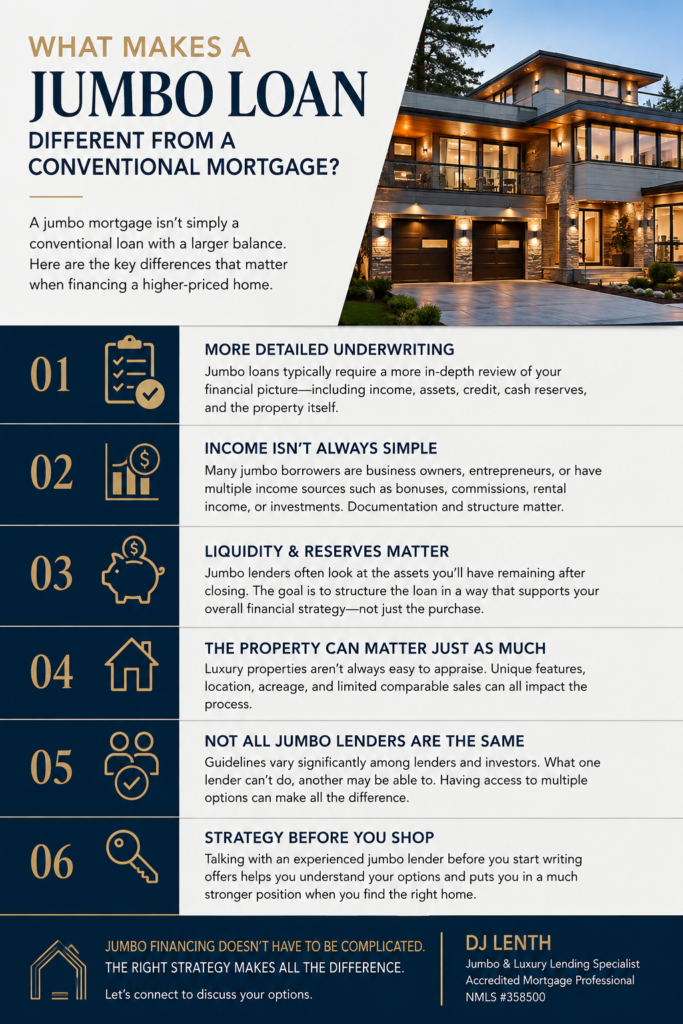
A jumbo mortgage isn’t simply a conventional mortgage with a bigger number attached to it.
The underwriting can be more detailed, the financial planning becomes more important, and choosing the right loan structure can make a significant difference.
But complicated doesn’t have to mean difficult.
When the financing is reviewed and structured properly from the beginning, jumbo buyers can approach the market with confidence and know exactly what they’re capable of doing.
If you’re considering purchasing a higher-priced home, let’s review the financing before you start writing offers.
The right jumbo strategy begins with understanding the entire financial picture—not simply finding an interest rate.
DJ Lenth
Jumbo & Luxury Lending Specialist
Accredited Mortgage Professional | NMLS #358500
Answer Home Loans